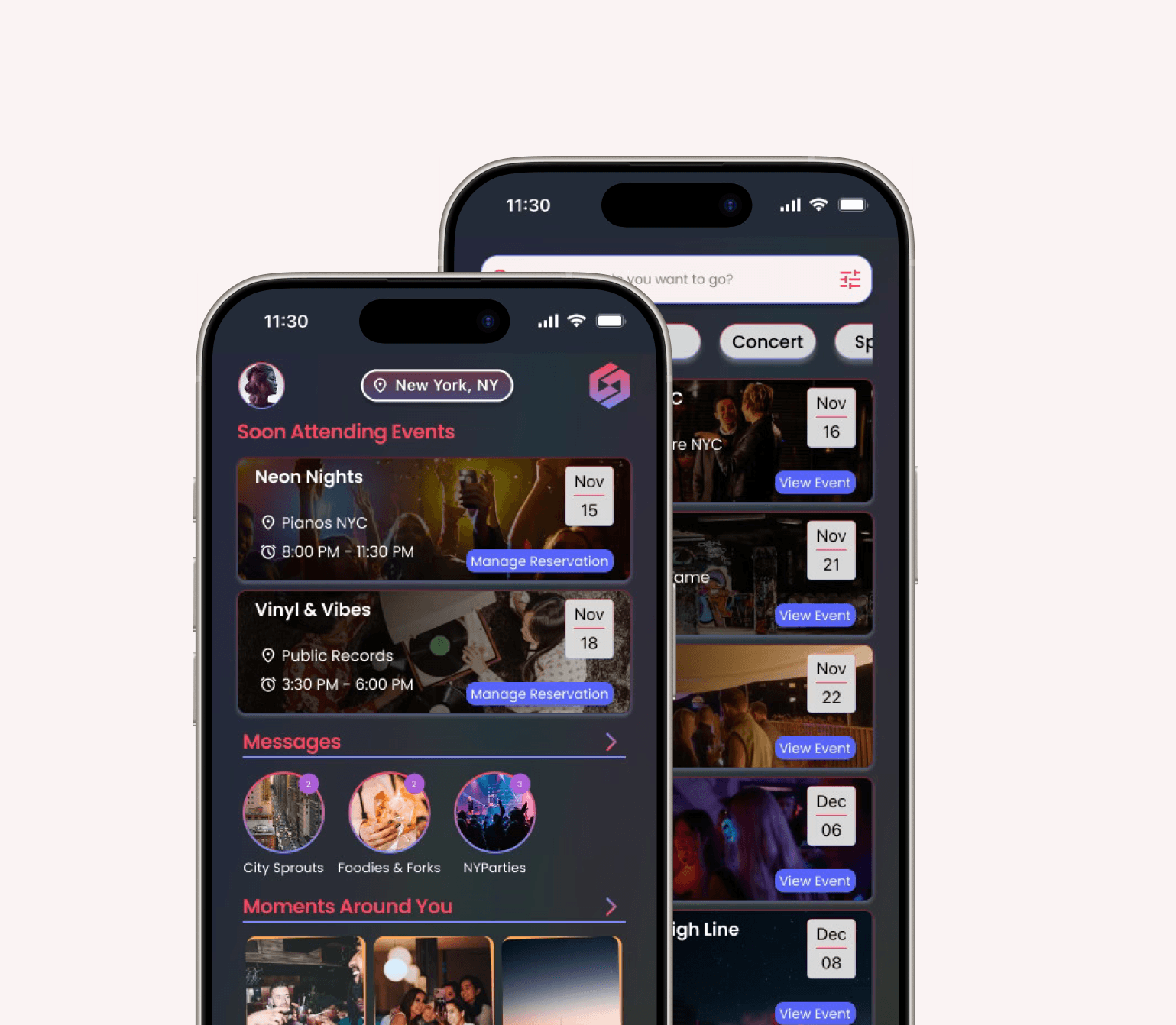
Moving somewhere new means missing everything worth going to. Eventra puts the city in one feed.
Eventra is a local event app that helps newcomers explore their city with ease. It brings event discovery, group connections, and photo sharing into one clean interface, making it easier to find things to do, meet people, and feel at home.
Problem
Newcomers miss events that match their interests and schedule, either from weak discovery tools or from cluttered event platforms.
Solution
Eventra curates events by interest, filters by location, time, and category, and lets newcomers save or register in a few taps.
Product Designer
FigmaOct 2025 - Dec 2025Mobile App
five courses, one trip
Let’s Break My Process Down
Research
The research explored how users, initially college students, later expanded to include young professionals and newcomers to a city, discover social events. While students were a natural starting point, it is discovered that event discovery challenges were shared across broader newcomer demographics.
Many users expressed difficulties navigating scattered platforms, making new connections, and finding events that felt relevant and welcoming. This insight led to a broader focus on newcomers, not just students, to design a solution that is inclusive, scalable, and adaptable across life stages.
User Interviews
To understand behaviors, motivations, and frustrations around attending events in a new environment.
Interview Insights
- Students often feel disconnected from social life during their first semester, especially when busy with classes or heavy course loads.
- Many rely on emails, word of mouth, or friends to find events, but information is scattered and easy to miss.
- Free food and social gatherings are the most appealing, they provide low-pressure ways to connect and save time or money.
- Several students mentioned missing events they would’ve attended because they didn’t hear about them in time.
- Discovery often depends on being part of active friend groups or following the right Instagram pages, creating unequal access to information.
- Students want a centralized, simple event hub that lists what’s happening around campus that is ideally updated weekly to avoid overload.
- Convenience and accessibility are key; students don’t want to spend time searching through emails or multiple apps.
- Personalization is valued, users want to see events that match their interests or what friends are attending.
- There’s a strong desire for something that feels authentic, social, and student-driven, not just an official university tool.
- Once students start attending more events, they feel more connected, comfortable, and confident navigating campus life.
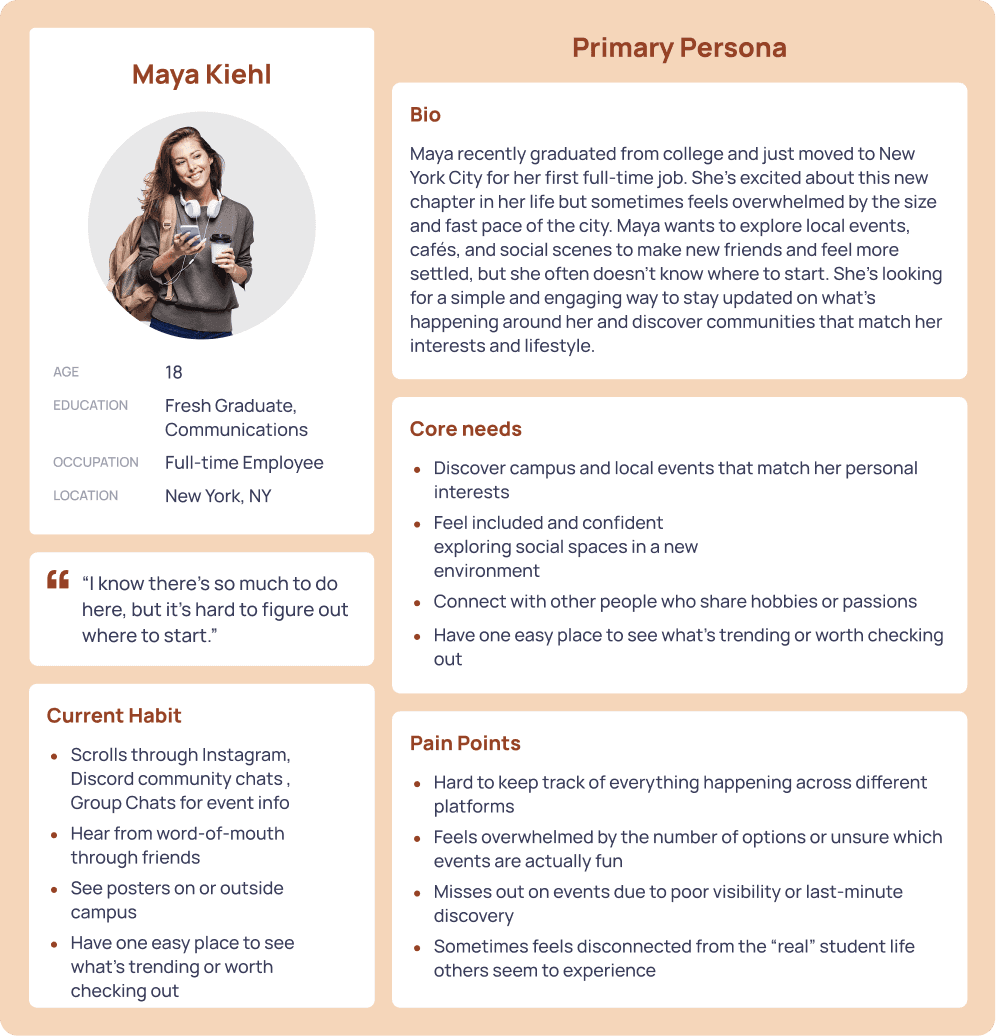
Persona Development
To represent newcomers, highlighting shared goals and unique constraints.
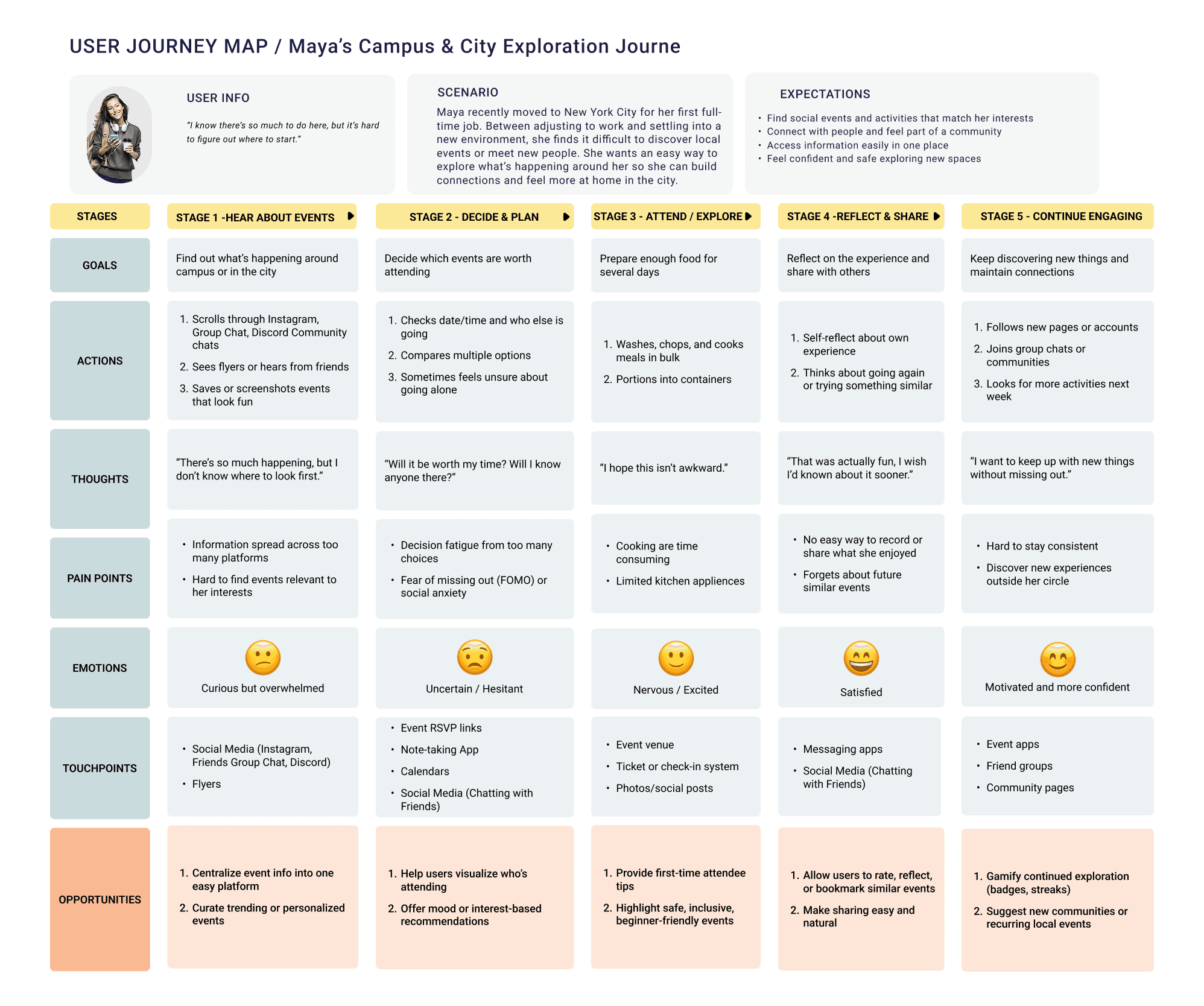
Journey Mapping
To visualize the emotional and practical stages users go through when discovering and planning events.
Competitive Analysis
To evaluate three existing platforms (CampusGroups, Eventbrite, and Meetup), identifying gaps and opportunities for improvement.
| Features / Criteria | CampusGroup | MeetUp | Eventbrite |
|---|---|---|---|
| Audience | CampusGroupStudent Only | MeetUpPublic | EventbritePublic |
| Community Groups | CampusGroupYes: School clubs and organizations | MeetUpYes: User-created Groups | EventbriteNo: Events only |
| Interest focused Event Discovery | CampusGroupNo: Emphasizes organizational affiliation over open discovery | MeetUpYes: Strong interest filtering | EventbriteYes: Some Filtering options |
| Pricing Visibility | CampusGroupYes: Listed | MeetUpYes: Listed | EventbriteYes: Listed |
| Event Info Clarity | CampusGroupNo: Often vague or minimal | MeetUpYes: Varies by organizer | EventbriteYes: Clear & well-formatted |
| Group Info Clarity | CampusGroupYes: Available | MeetUpYes: Available | EventbriteNo: Not Applicable |
| UI Simplicity / Aesthetic | CampusGroupNo: Outdated, somehow cluttered | MeetUpYes: Intuitive nut basic / outdated | EventbriteYes: Modern & clean |
| Mobile Experience (Engagement) | CampusGroupNo: Functional, but not engaging | MeetUpYes: Engaging | EventbriteYes: Smooth and modern |
Diary Task
To track participants' thoughts, decisions, and behaviors in real-time as they tried to find and attend social events over several days.
Diary Study Questions
- What did you do today (in detailed and chronological order) that helped you explore or connect with your city?(e.g., attended a social event (campus or non-campus related), visited a café, joined a club, explored a new area, or even stayed in and saw something online)
- How did you find out about this activity or place?(e.g., social media, word of mouth, posters, local apps, campus newsletters, etc.)
- What motivated you to check it out (or not to go)?
- How did it make you feel?(e.g., welcomed, disconnected, curious, overwhelmed, inspired)
- What challenges did you face in finding or joining the experience, if any?
- What could have made discovering this event or experience easier or more enjoyable?
- Add any visuals if possible, like a flyer, social post, or photo that captures what you noticed today.
Key Findings
Three findings shaped what Eventra needed to solve for newcomers.
Limited Discoverability of Events
People struggled to explore events that matched their interests. Existing platforms felt cluttered or too broad, with few tools to personalize or narrow down search results by time, interest, or location.
Lack of Meaningful Community Connections
People didn’t just want to attend events, they wanted to belong. They felt disconnected from existing groups or communities, with no clear way to join like-minded people or understand group dynamics before committing.
Overwhelming Interfaces and Friction in Planning
Participants often felt overwhelmed by dense event listings and scattered planning tools. There was a strong desire for a simplified, mobile-friendly experience that could streamline event discovery, RSVP, and calendar integration.
Design
The design focused on creating a mobile-first platform that enables seamless event discovery, encourages community participation, and enhances user engagement through intuitive navigation and personalization features.
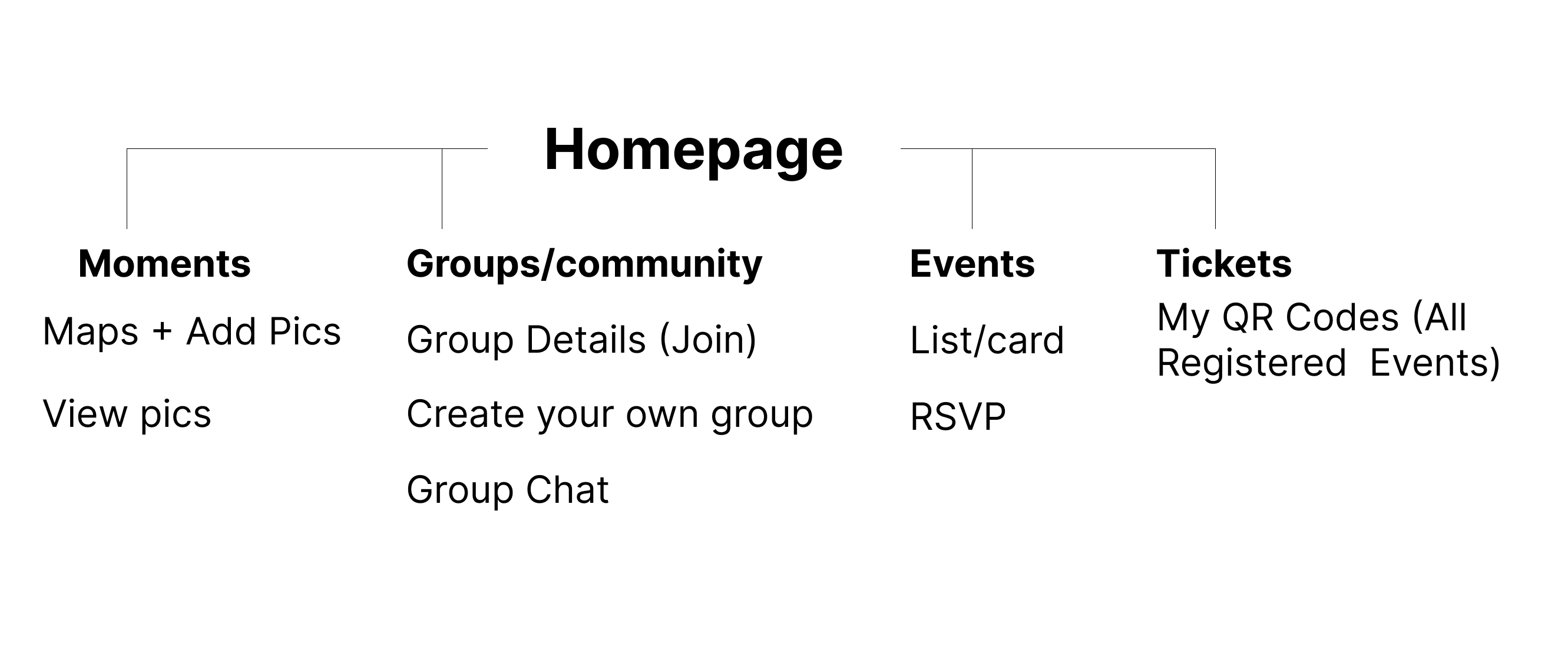
Site Mapping
Mapped out core user flows for exploring, joining, and creating events to ensure clarity across the platform’s structure.
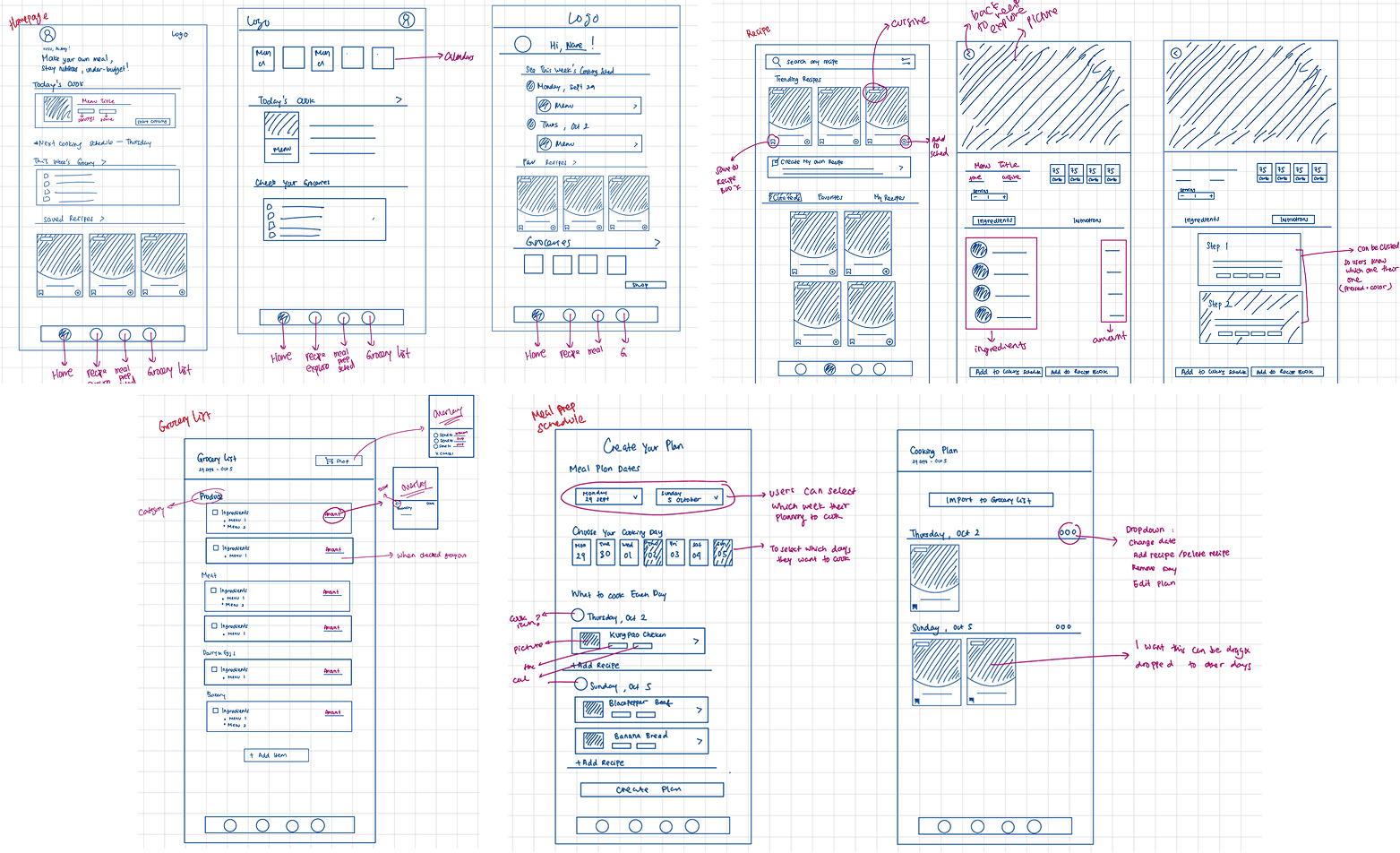
Sketching
Visualized early layout concepts for the home feed, event detail page, filters, and community features.
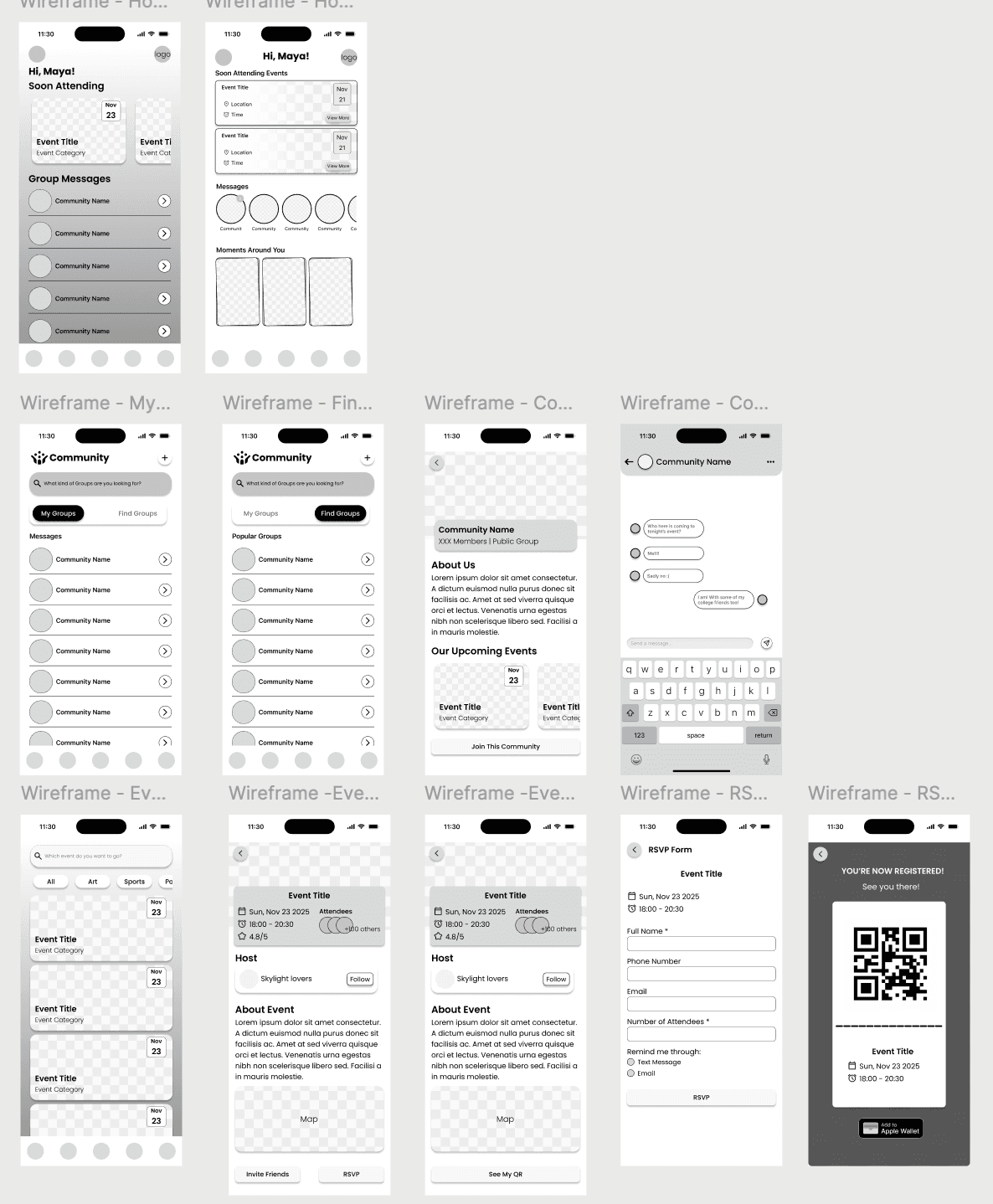
Wireframing
Built mid-fidelity wireframes to define layout, interaction flow, and component behavior.
Hi-Fi Prototyping
Developed a high-fidelity prototype to reflect brand identity and test real interactions.
Accessibility Testing
Reviewed color contrast, touch targets, and element spacing to align with WCAG 2.1 AA standards and ensure an inclusive, mobile-accessible experience.
Progress Check
Gathered targeted feedback on navigation, clarity, and accessibility
Refinement
Iterated on designs based on insights (e.g., improving search filters, updating icons, and enhancing accessibility).
Overall Design Phase
The hardest problem, the biggest win, and the change that came directly out of critique.
Key challenge
Balancing Eventra’s dark, vibrant visual style with readability and accessibility, especially for high-frequency actions like “Manage Reservation” and navigation buttons.
Key accomplishment
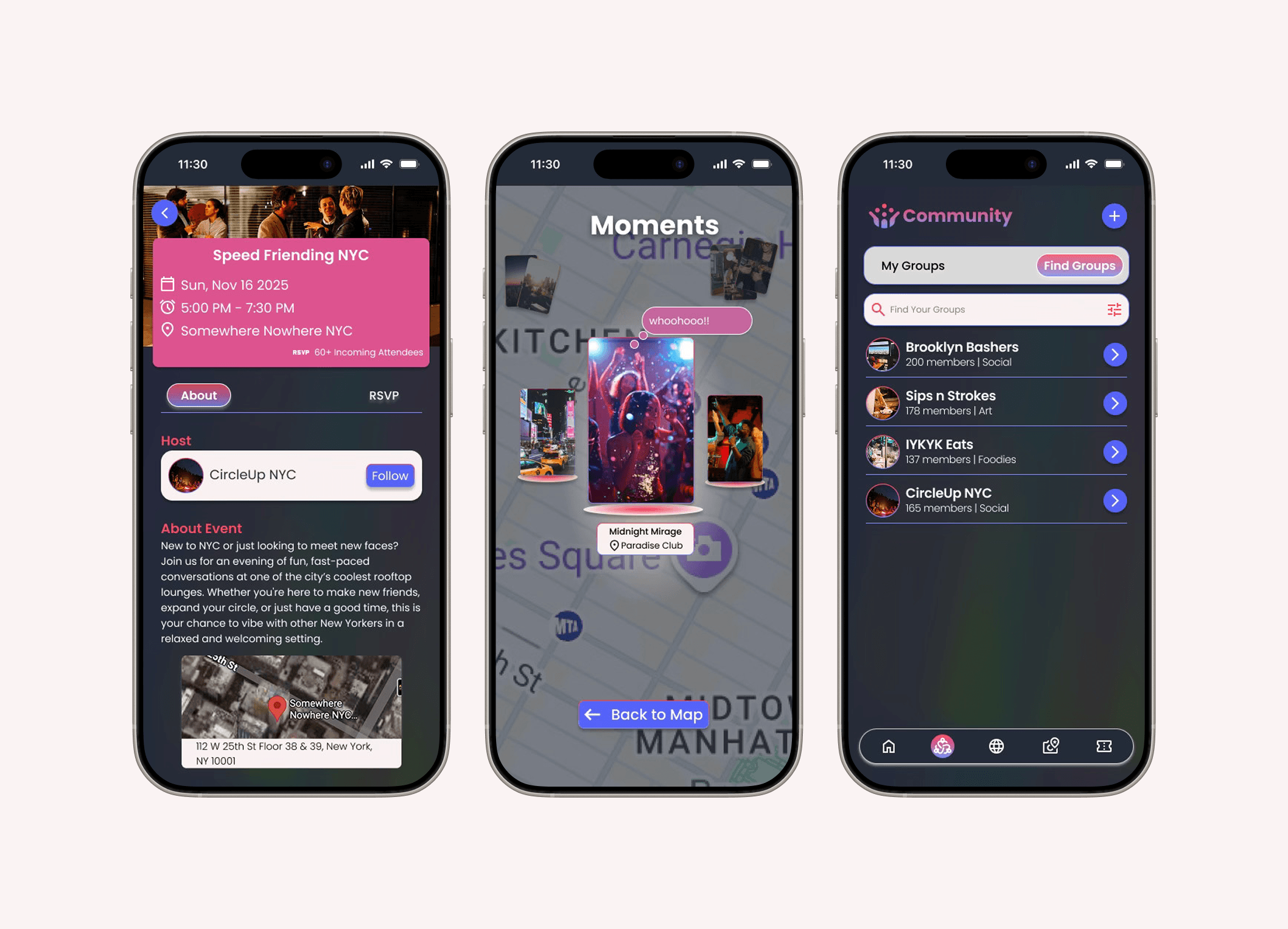
Designing separate overlay filter panels for Events and Groups so users could narrow results quickly (time, location, category, size, price) without breaking the browsing flow.
Key iteration from feedback
After my advisor's critique, I used a WCAG contrast checker to adjust button colors to a darker purple-blue, standardized icon style across screens, and updated group cards to display member count + category for faster scanning.
Results
Key Contributions & Design Decisions
Personalized Event Feed
Designed an interest-based event feed that adapts to user preferences, improving discoverability and reducing decision fatigue.
Community-Centric Features
Integrated follower and group functions that highlight what peers are attending, fostering social belonging and campus connection.
Streamlined Exploration & Filters
Created mobile-friendly filters and search interactions to help students quickly find relevant events across categories.
Moments Photo Wall
Introduced a dedicated space for users to share and browse event photos, helping build excitement, showcase memories, and drive post-event engagement.
Reflection
What I learn..
Key takeaways from the project
Discoverability Is Emotional, Not Just Logical
Users weren’t just looking for events; they were looking for belonging, identity, and low-friction discovery.
Peer Presence Drives Engagement
Seeing what friends or clubs are attending influenced event turnout more than event content or design.