Shoppers guess at fit and jump between apps to style one outfit. STYLD holds it all in one place.
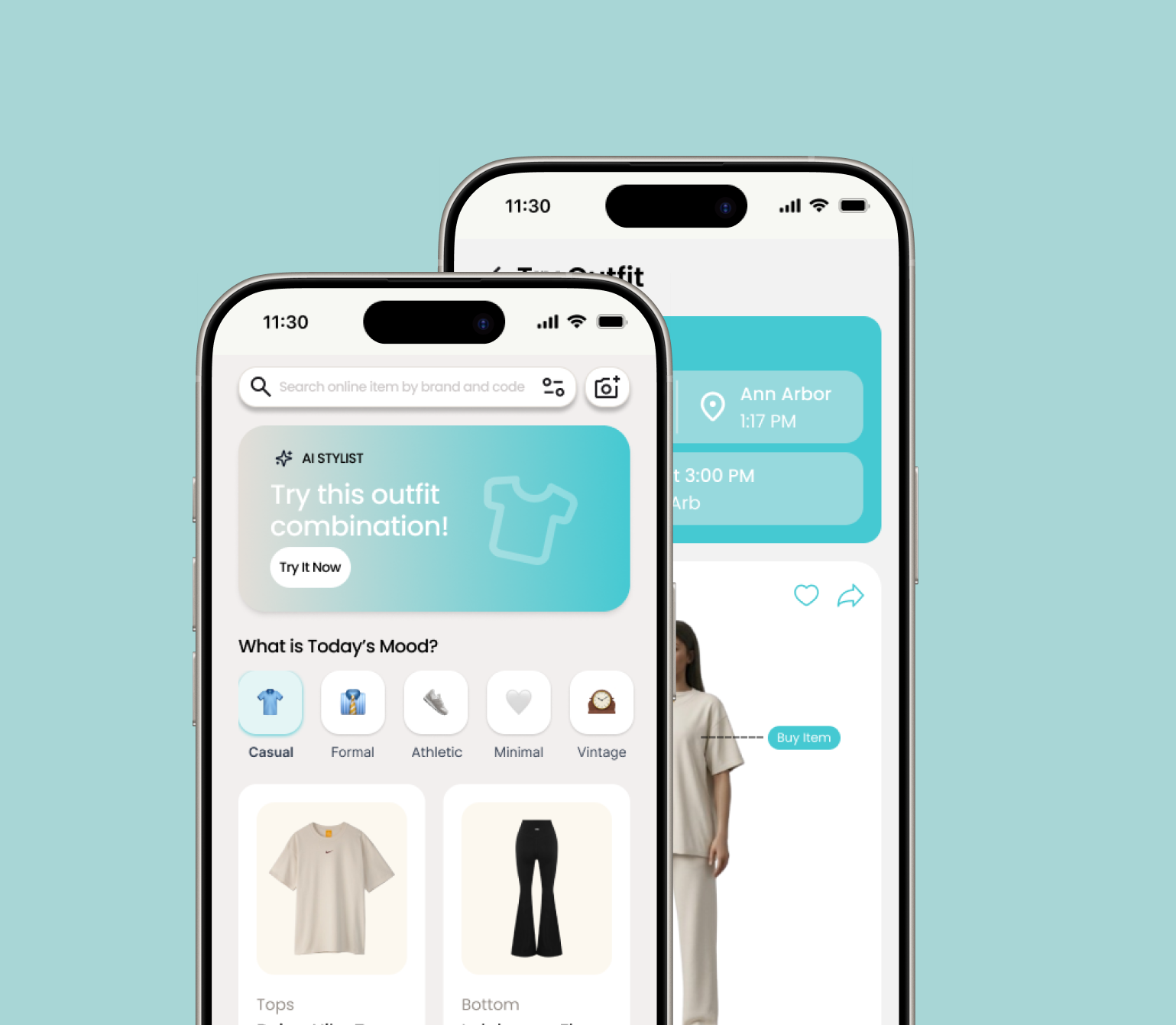
STYLD is a personalized fashion styling platform that brings AI styling recommendations, a digital wardrobe, 3D virtual try-on, and social feedback into one experience, helping users cut decision fatigue and shop online with more confidence.
Problem
Styling inspiration lives on one app and shopping on another, so shoppers guess at fit and return what does not work.
Solution
STYLD combines AI styling, a digital wardrobe, 3D try-on, and feedback from friends into one flow before checkout.
Product Designer (Team Project)
FigmaFigJamApril 2026Mobile App
five courses, one trip
Let’s Break My Process Down
Research
The research and strategy phase focused on understanding the opportunity space around online shopping, outfit planning, wardrobe management, and virtual try-on. We began by defining user problems and potential features, then developed the product concept through a series of strategic frameworks before moving into design.
After defining the initial concept, we used several frameworks to understand the user experience, market opportunity, service ecosystem, and potential business model.
Ideation
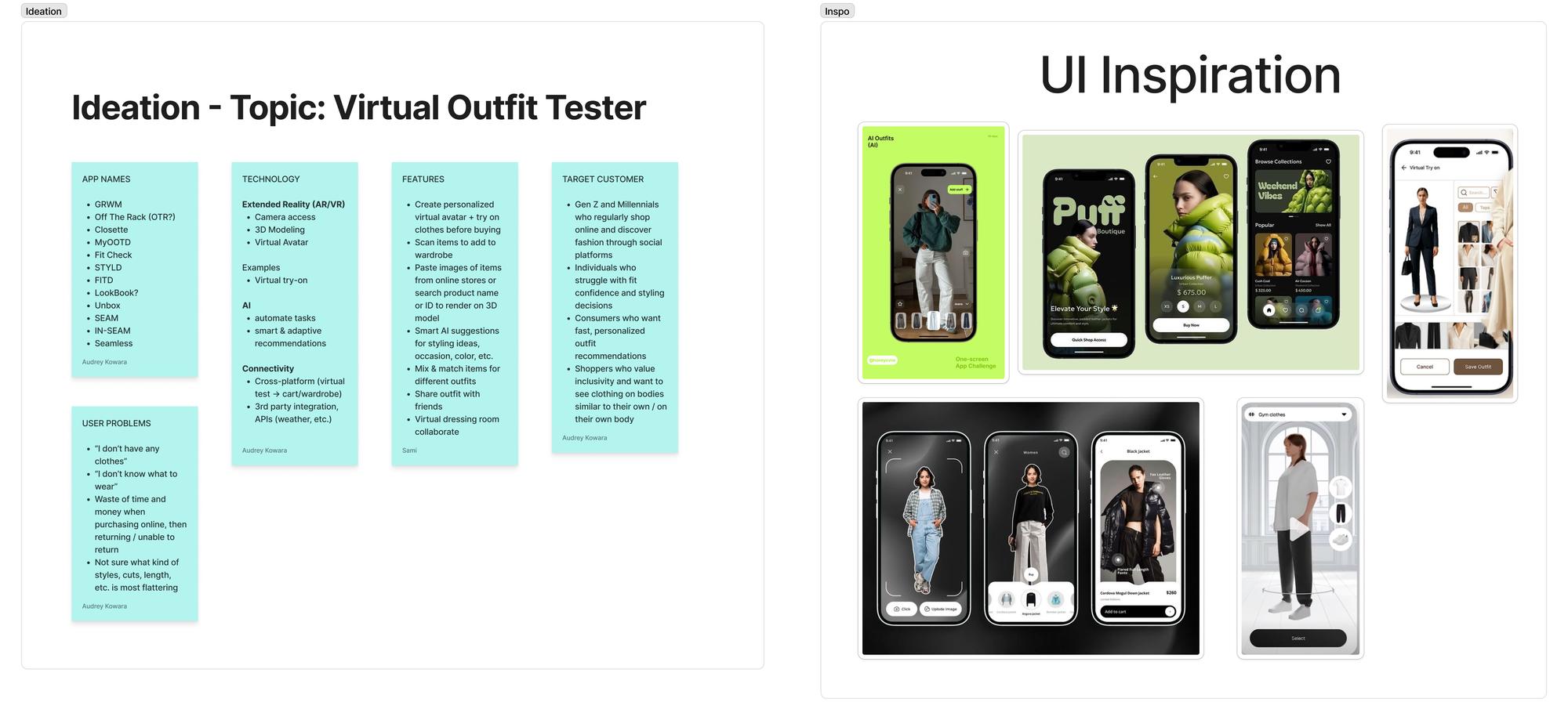
Brainstormed opportunities around a Virtual Outfit Tester, identifying potential users, technologies, features, and problems the product could address.
Our initial exploration focused on:
- Personalized virtual avatars and 3D try-on
- AI-powered styling recommendations
- Digital wardrobe management
- Outfit creation and mix-and-match functionality
- Social sharing and collaborative feedback
- Integration with online retailers
The primary target users were Gen Z and Millennials who regularly shop online, discover fashion through social platforms, and experience uncertainty around styling, fit, and purchase decisions.
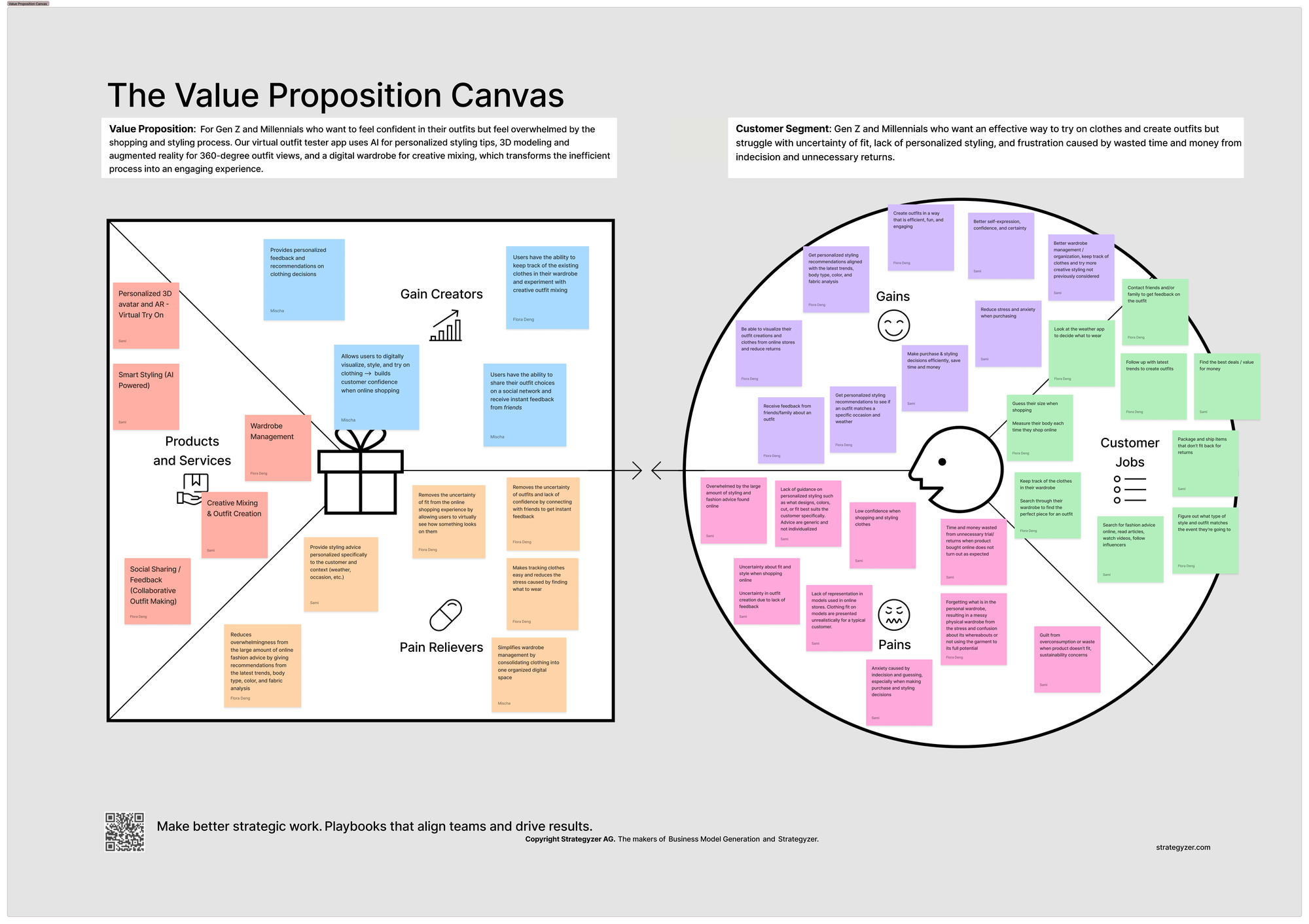
Value Proposition Canvas
Mapped users' jobs, pains, and gains against STYLD's proposed features to understand where the product could provide the strongest value.
The resulting value proposition centered on helping users feel more confident in their outfits while reducing the uncertainty and inefficiency of online shopping through AI styling, 3D modeling, augmented reality, and digital wardrobe management.
Market / Ecosystem Map
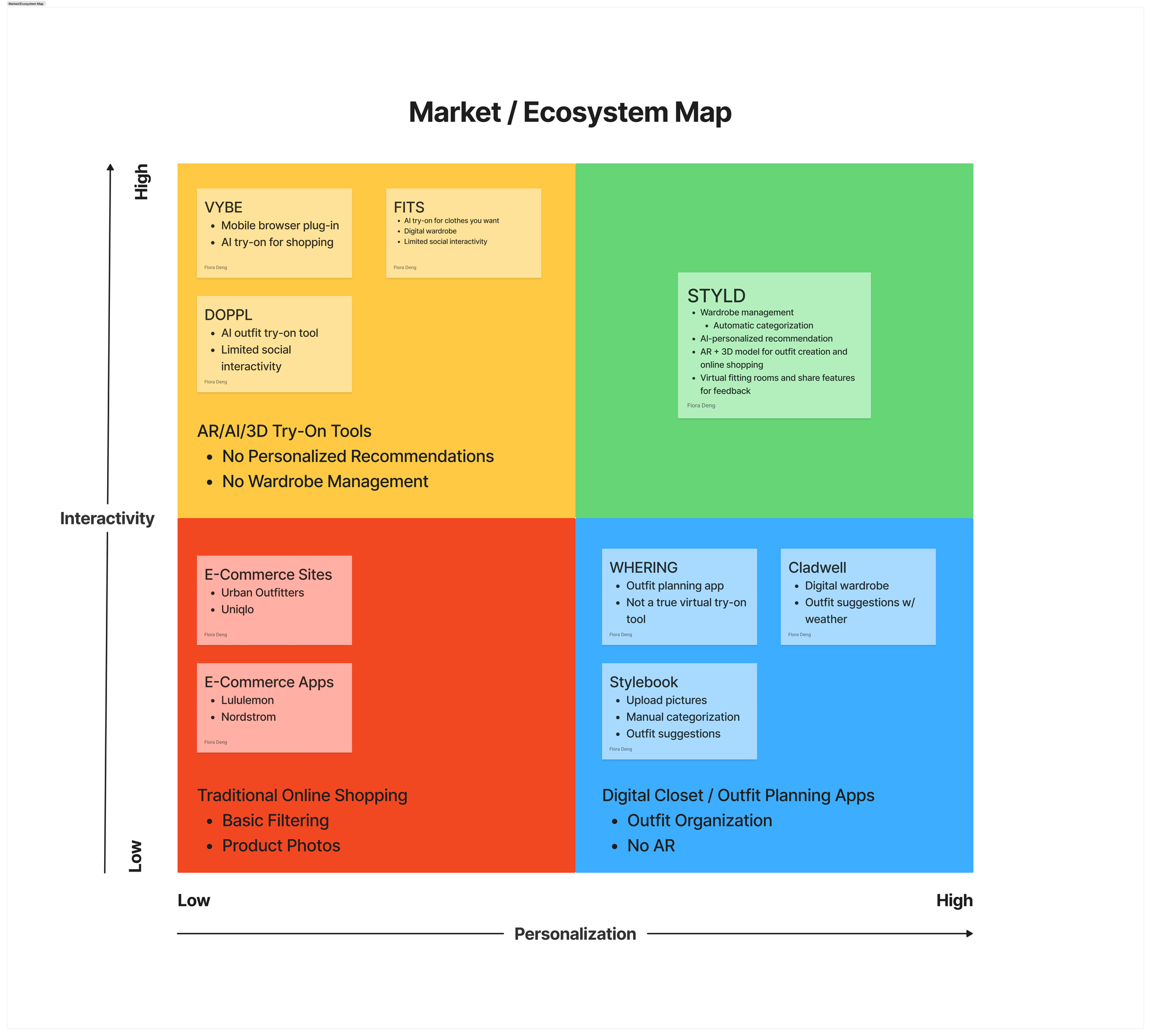
Compared STYLD against traditional e-commerce platforms, digital closet and outfit-planning apps, and existing AR/AI/3D try-on tools.
The analysis positioned STYLD around two dimensions: personalization and interactivity. Existing solutions typically specialized in either virtual try-on or wardrobe organization. STYLD's opportunity was to combine wardrobe management, AI-personalized recommendations, AR + 3D outfit creation, online shopping, virtual fitting rooms, and social feedback within one ecosystem.
Service Blueprint
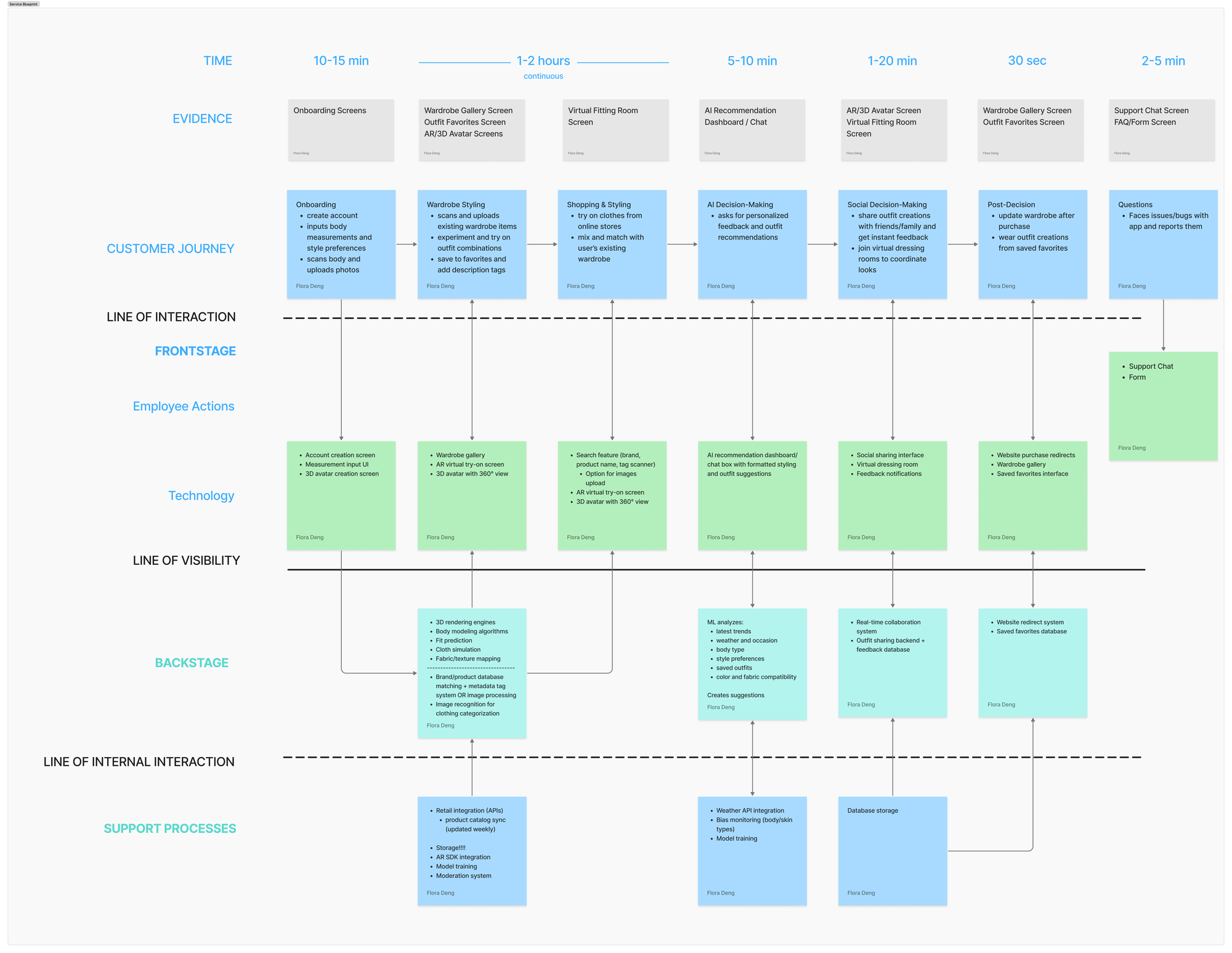
Mapped the complete experience from onboarding through wardrobe styling, shopping, AI recommendations, social decision-making, post-purchase wardrobe updates, and customer support.
The blueprint connected the customer journey with:
- Frontstage interactions
- Technology requirements
- Backstage systems
- Support processes
This helped us understand not only what users would interact with, but also the technology and services required to support features such as 3D rendering, body modeling, AI recommendations, retailer APIs, wardrobe storage, and social collaboration.
Business Model Canvas
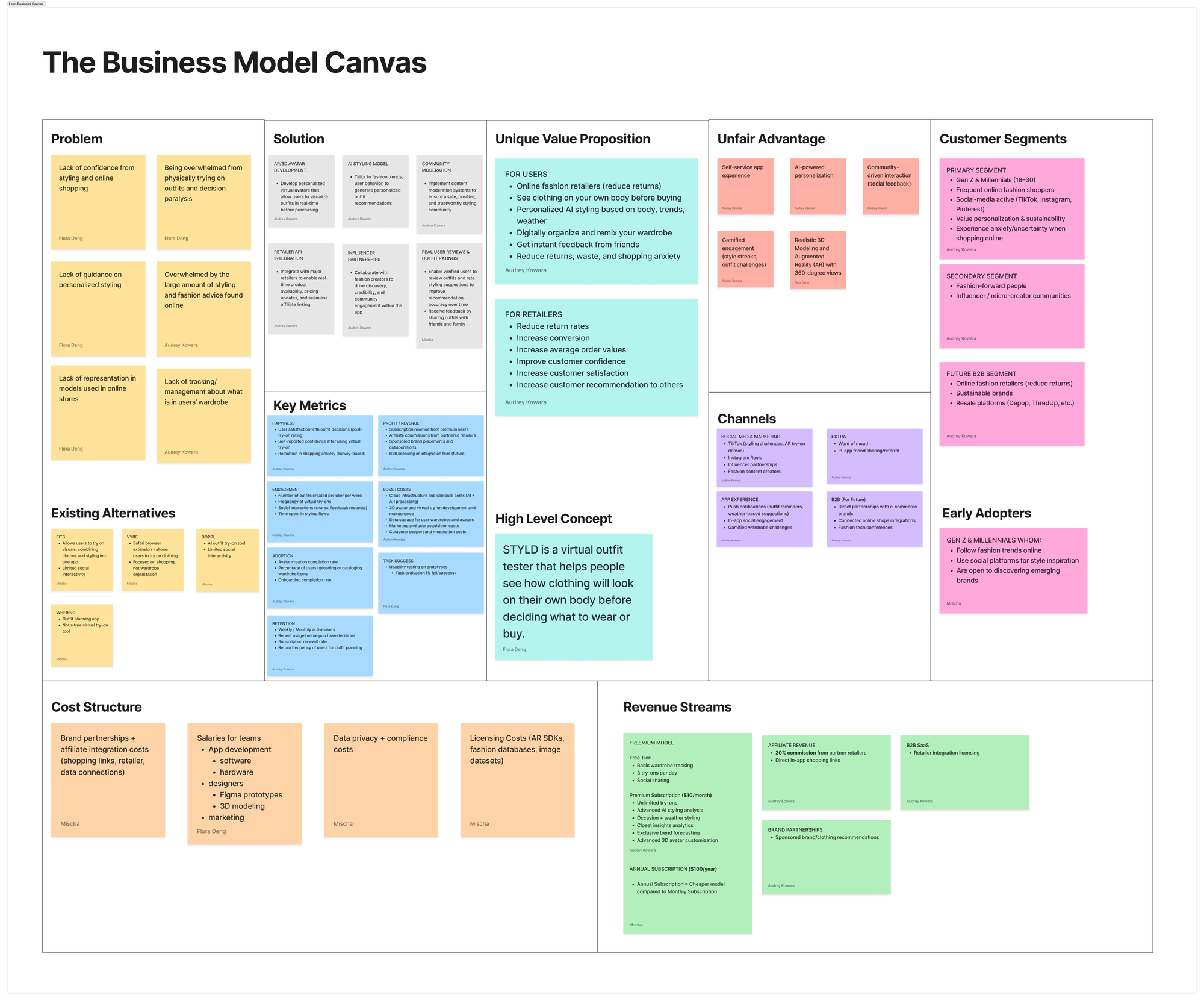
Explored how STYLD could deliver value to both users and retailers while remaining financially sustainable.
The initial model considered:
- Freemium subscriptions
- Affiliate revenue
- Brand partnerships
- Retailer integrations
- B2B SaaS opportunities
This established an initial business hypothesis that we could later evaluate through user feedback.
Design
After defining the opportunity and product strategy, we translated the concept into an interactive prototype. The design focused on creating a personalized fashion experience that reduces uncertainty and makes outfit planning and online shopping easier, more visual, and more confidence-driven.
Design & Prototype
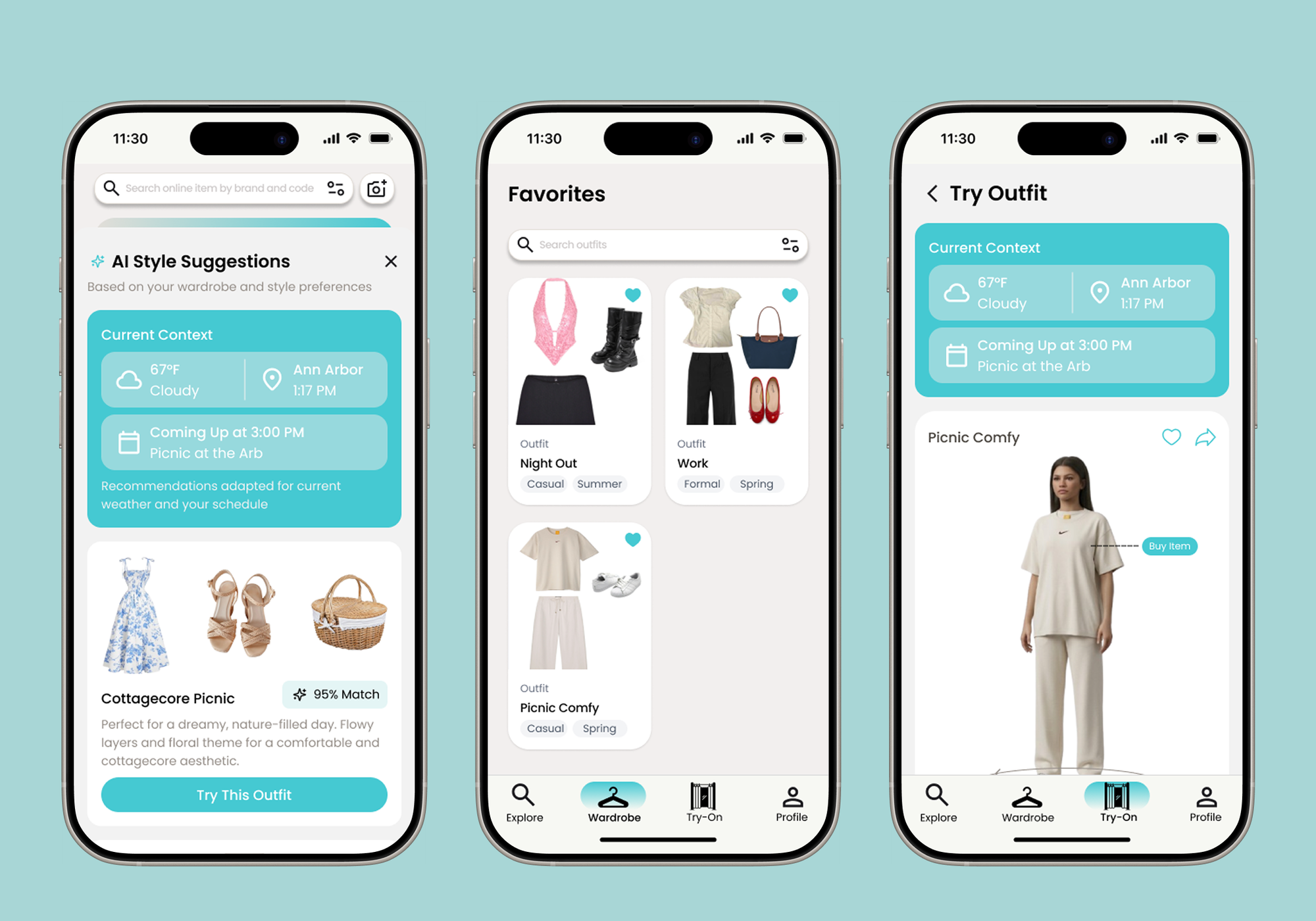
The prototype brought together the core STYLD experience.
AI-Powered Personalized Styling
Personalized outfit recommendations help users discover combinations based on their wardrobe, preferences, occasion, trends, and other contextual factors.
Digital Wardrobe
Users can organize and keep track of their existing clothing, helping them better understand what they already own and discover new combinations.
3D Virtual Try-On
Users can visualize clothing and outfit combinations on a personalized avatar before deciding what to wear or purchase.
Outfit Creation & Saving
Users can create combinations, save favorite outfits, and revisit them when planning what to wear.
Social Feedback
Users can share outfit options and receive feedback from friends, adding another source of confidence when making styling decisions.
Feedback & Refinement
After developing the prototype, we conducted 20–30 minute semi-structured user interviews combined with moderated usability testing. Prototype testing was embedded directly within the interviews.
We tested with 5 Gen Z and Millennial participants, particularly college students and young professionals who frequently shop online, have an interest in fashion, and spend time planning outfits. We collected qualitative feedback, observed usability behaviors and confusion points, and evaluated perceived value, willingness to use or pay, and feature prioritization.
Affinity Diagram
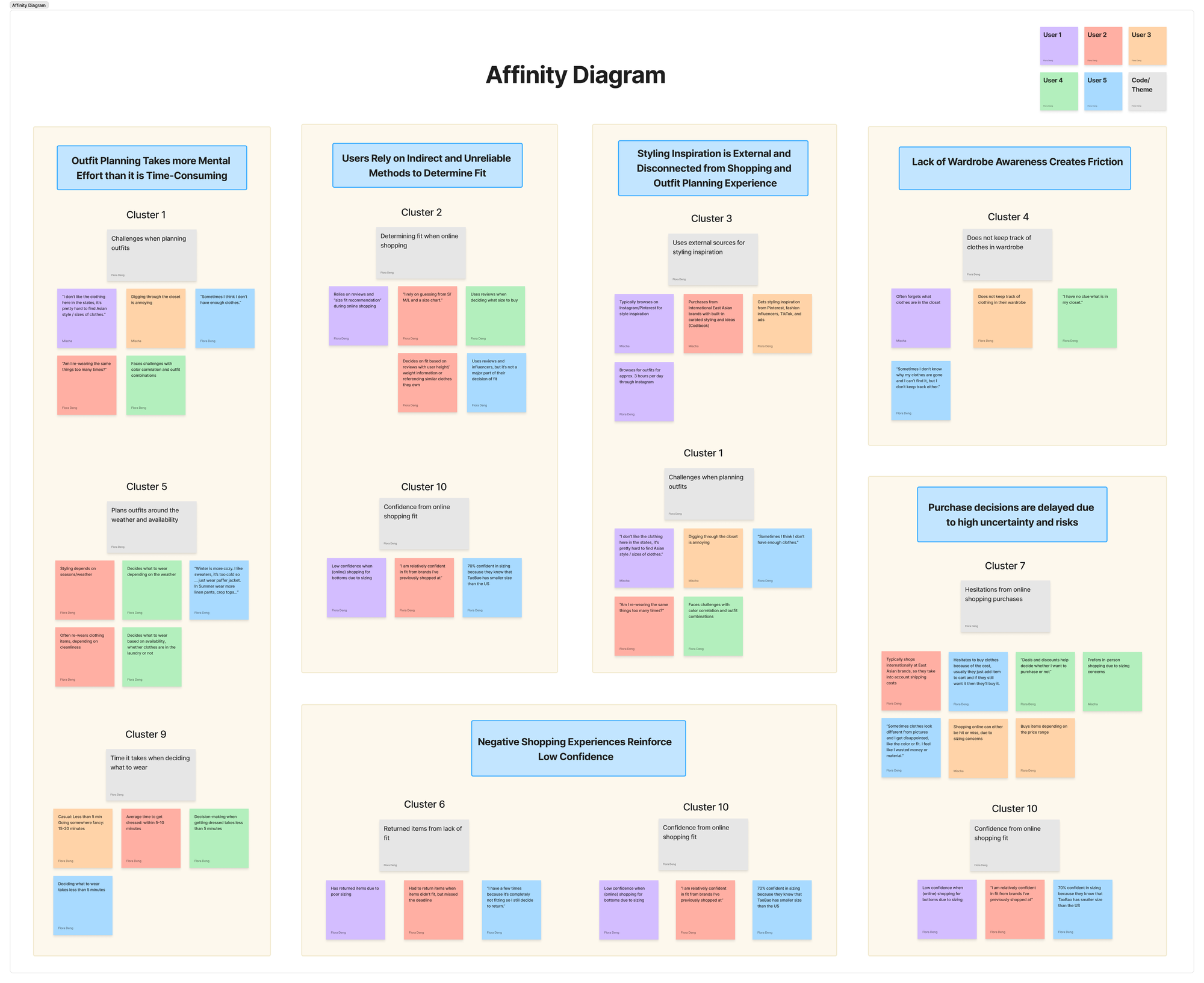
Synthesized interview data using thematic analysis and an affinity diagram, grouping similar quotes, behaviors, and observations to identify recurring patterns across participants.
Key Findings
Six findings explained why getting dressed and shopping online both felt harder than they should.
Outfit Planning Takes More Mental Effort Than It Is Time-Consuming
Users typically make outfit decisions within 5–10 minutes, but the process involves uncertainty around coordination, repetition, and context.
Lack of Wardrobe Awareness Creates Friction
Most users were unsure of what items they owned, contributing to inefficient outfit planning and underutilization of existing clothing.
Users Rely on Indirect and Unreliable Methods to Determine Fit
Reviews, recommendations, and size charts provide fragmented signals, resulting in low confidence when shopping online.
Negative Shopping Experiences Reinforce Low Confidence
Poor fit and mismatched expectations contributed to dissatisfaction, returns, and reduced trust in online shopping.
Styling Inspiration Is Abundant but Disconnected
Users frequently rely on social media and external platforms for inspiration, but those ideas are not directly integrated into their wardrobe or shopping decisions.
Purchase Decisions Are Delayed by Uncertainty and Risk
Concerns about sizing, returns, wasted time, and money made users more hesitant when purchasing clothing online.
Prototype Testing
Users were generally able to complete the main prototype tasks, including searching for items, using AI suggestions, saving favorites, and sharing outfits.
However, testing revealed several important signals:
4/5Users
identified the wardrobe gallery as a must-have feature.
2/5Users
identified 3D avatar try-on as a must-have feature.
3/5Users
said they would use STYLD a couple of times per week.
2/5Users
felt manually adding clothing to the wardrobe took too much time.
5/5Users
said they would not pay for STYLD.
Iteration & Refinement
The findings directly shaped both the product design and business strategy.
Simplify Navigation With Labeled Icons
We proposed replacing ambiguous icons with labeled ones and introducing lightweight onboarding cues, so core features are easier to recognize and the navigation bar is easier to move through.
Scan Full Outfits to Reduce Wardrobe Setup Friction
We proposed letting users scan full outfits at once with automatic categorization of multiple clothing items, and connecting STYLD to users' emails so purchase receipts generate wardrobe items on their own. Together these take most of the manual effort out of building a digital wardrobe.
Feature Prioritization
User feedback helped prioritize the features that demonstrated the strongest value.
- Wardrobe management
- Virtual try-on
- Outfit saving
Features such as AI suggestions, mood prompts, and in-app chat were considered less essential by some users.
Business Model Pivot
The original subscription hypothesis was challenged by testing: 5/5 participants said they would not pay for STYLD.
This led us to reassess the business model by expanding free access to core functionality while relying more heavily on alternative revenue streams such as affiliate revenue, advertising, brand partnerships, and retailer integrations.
Results
Key Contributions & Design Decisions
Feature Prioritization
Wardrobe management, virtual try-on, and outfit saving.
UX Improvements
Simplified navigation, labeled icons, easier onboarding, and reduced wardrobe setup friction.
Business Strategy
Shift away from dependence on subscriptions toward a more accessible model supported by affiliate revenue, brand partnerships, advertising, and retailer integrations.
Validation & Impact
Our testing showed strong desirability for STYLD's core functionality while revealing limitations in the initial usability and monetization approach.
The desirability testing supported two major hypotheses:
- Users want to reduce the effort involved in planning outfits.
- Users experience uncertainty about fit and style when shopping online.
Testing also supported the viability hypothesis that users would use the app regularly, with 3/5 participants indicating weekly or more frequent use. However, willingness to pay was not validated, requiring us to reconsider the original monetization strategy.
Reflection
What I learn..
Four lessons from taking a multi-feature fashion platform from strategy through testing.
Early Strategy Connects User Needs to the Larger Product Ecosystem
The Value Proposition Canvas, Market Map, Service Blueprint, and Business Model Canvas helped us think beyond individual screens and understand how user needs, technology, market positioning, and business viability connect.
Feature Value Needs to Be Validated With Users
Usability testing helped identify which features users actually considered essential, allowing us to prioritize wardrobe management, virtual try-on, and outfit saving.
Small Navigation Decisions Affect the Entire Experience
Confusion around unlabeled icons made otherwise straightforward tasks harder to complete, reinforcing the importance of clarity over visual minimalism.
Product Design Extends Beyond the Interface
User feedback influenced not only UX improvements but also feature prioritization and the business model, showing how design research can shape broader product strategy.